
Securing Revenue Cycle Management (RCM) with Enterprise-Grade Information Security & Compliance
As RCM operations scaled, the organization faced significant security and compliance gaps. Sensitive Protected Health Information (PHI) and payment data were increasingly exposed to cyber threats, particularly across billing and claims systems.
- 15 min read

Client Overview
A mid-to-large healthcare provider operating across multiple hospitals and diagnostic centers was managing complex Revenue Cycle Management (RCM) processes, including patient registration, insurance verification, claims processing, billing, and payments.
With increasing digital transactions and growing regulatory scrutiny, ensuring the security and compliance of sensitive financial and clinical data became a critical priority.
Business Challenge
As RCM operations scaled, the organization faced significant security and compliance gaps. Sensitive Protected Health Information (PHI) and payment data were increasingly exposed to cyber threats, particularly across billing and claims systems.
The environment lacked a unified compliance framework, with requirements spanning HIPAA and PCI DSS. Access controls were fragmented, audit mechanisms were inconsistent, and there was limited visibility into third-party vendor risks. Additionally, the absence of centralized monitoring and structured incident response made it difficult to detect and respond to threats in real time.
These challenges introduced financial, legal, and reputational risks, especially as digital payment adoption increased across RCM workflows.
Solution Overview
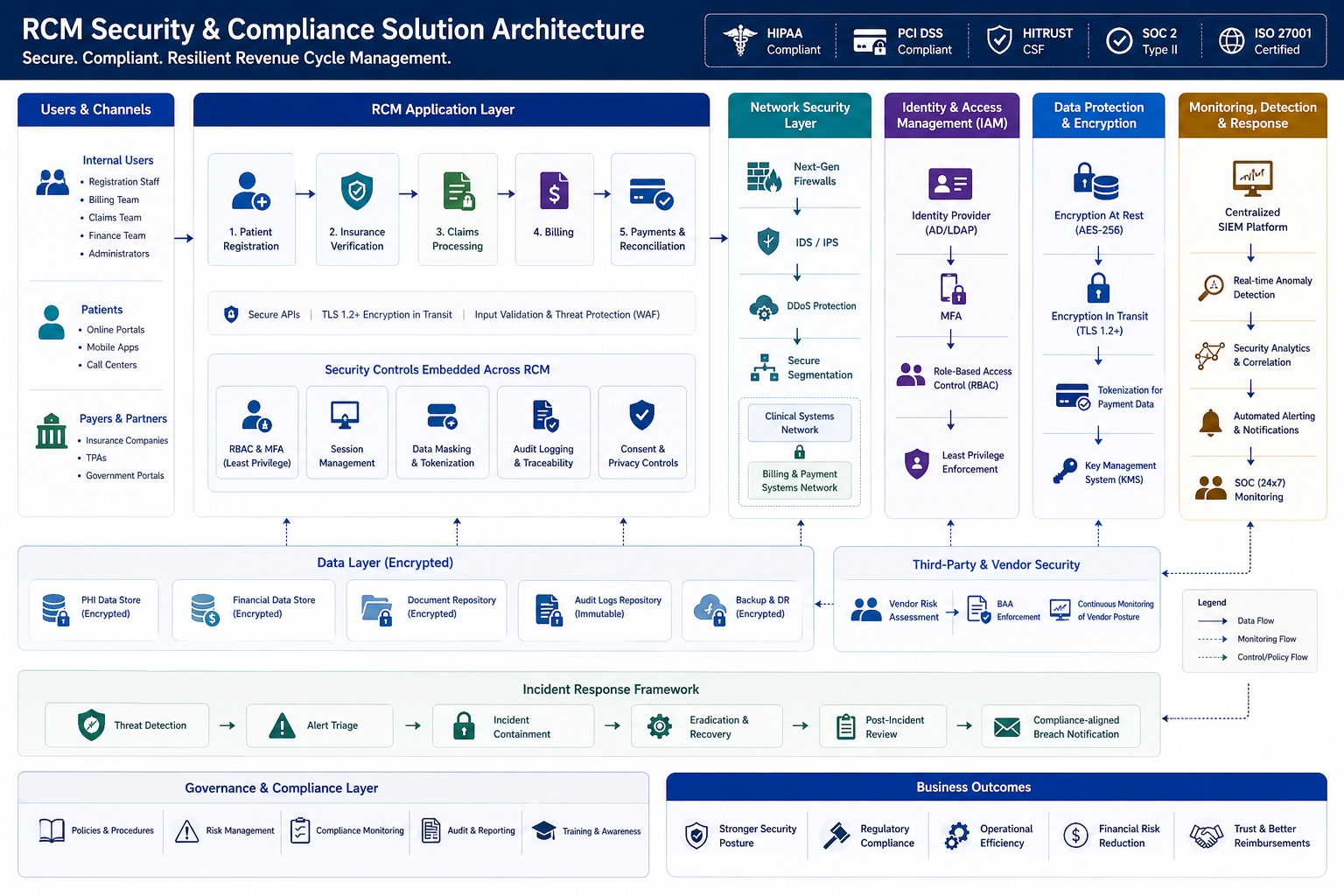
To address these challenges, a comprehensive RCM security and compliance framework was implemented—designed to secure sensitive data, standardize access controls, and enable continuous monitoring across the entire revenue lifecycle.
Data Protection & Encryption
Sensitive healthcare and payment data were secured using end-to-end encryption. PHI was protected both at rest (AES-256) and in transit (TLS 1.2+), while tokenization was introduced to reduce PCI exposure for payment data.
Identity & Access Management (IAM)
A structured access control framework was implemented using Role-Based Access Control (RBAC) and Multi-Factor Authentication (MFA). Access policies were aligned with the principle of least privilege, ensuring that users across billing and claims systems only accessed what was necessary.
Network Security Architecture
The infrastructure was strengthened with advanced firewall configurations and Intrusion Detection & Prevention Systems (IDS/IPS). Critical systems were segmented to isolate clinical environments from billing and payment systems, reducing the risk of lateral threat movement.
Continuous Monitoring & Logging
A centralized SIEM-based monitoring system was deployed to provide real-time visibility across all systems. This enabled continuous tracking of user activities claims processing, and payment transactions, supported by anomaly detection and comprehensive audit trails.
Incident Response Framework
A structured incident response capability was introduced with predefined playbooks for scenarios such as data breaches and ransomware attacks. Automated alerting and containment mechanisms improved response speed, while workflows were aligned with compliance requirements for breach notification.
Third-Party Risk Management
A formal vendor risk management framework was established, including security assessments, enforcement of Business Associate Agreements (BAAs), and continuous monitoring of third-party security posture.
Compliance Alignment
The solution ensured full alignment with key regulatory and industry standards:
- HIPAA: Implementation of administrative, physical, and technical safeguards, including risk assessments, workforce training, access controls, and audit logging
- PCI DSS: Secure handling of payment data through encryption, tokenization, vulnerability management, and strict access controls
- Global Frameworks: Alignment with HITRUST CSF, SOC 2 Type II, and ISO 27001 to strengthen audit readiness and trust
Business Outcomes
The implementation delivered measurable improvements across security, compliance, and operational efficiency:
- 70% reduction in vulnerability exposure
- Zero critical data breaches post-implementation
- Full compliance with HIPAA and PCI DSS requirements
- 60% improvement in audit readiness
- Faster and more secure claims processing
- Reduced manual effort in audits and compliance tracking
- Lower financial risk through avoidance of penalties and improved payer trust
Value Delivered
The organization successfully transitioned from a fragmented and reactive security posture to a proactive, compliance-driven RCM environment.
Security became embedded within operational workflows, enabling both protection and efficiency. The architecture is now scalable and cloud-ready, supporting future capabilities such as AI-driven fraud detection and advanced analytics.
Conclusion
By implementing a unified information security and compliance framework, the healthcare provider transformed its RCM operations into a secure, resilient, and audit-ready system.
This approach not only ensured protection of sensitive healthcare and financial data but also enabled more efficient revenue operations—making security a strategic enabler rather than a constraint in modern healthcare delivery.