
Unified Operational Records Access for Law Enforcement
To address these challenges, a unified federated search platform was designed to connect all operational data sources—irrespective of format, storage location, or language—into a single, intuitive interface.
- 10 min read

Background & Operational Challenge
A Department Under Karnataka State Police manages a vast and complex ecosystem of operational data spanning multiple formats, systems, and languages. This includes structured SQL databases with case records, scanned reports and field documentation, multilingual files in Kannada and English, as well as audio-video evidence from investigations.
Over time, this data grew into large, disconnected repositories distributed across regional hubs and legacy systems. While the information existed, accessing it efficiently remained a significant challenge.
Officers often spent multiple hours searching for basic case information, frequently relying on IT teams to retrieve documents. Critical records in Kannada were not easily accessible across systems, and coordination between regional units remained largely manual. These inefficiencies led to delays in investigations and missed opportunities for faster case resolution.
Approach Building a Unified Federated Search Layer
To address these challenges, a unified federated search platform was designed to connect all operational data sources—irrespective of format, storage location, or language—into a single, intuitive interface.
The solution focused on enabling seamless access while maintaining strict security and operational control.
Core Architecture
The platform was built on a scalable architecture combining:
- A bilingual OCR engine to digitize Kannada and English documents
- Intelligent indexing across structured databases and unstructured files
- NLP-powered semantic search for contextual query understanding
- Role-based access controls aligned to operational hierarchies
- Real-time synchronization across all connected data sources
Key Capabilities
The system enabled officers to:
- Search across case records, reports, and archives simultaneously
- Retrieve results across languages with built-in translation and transliteration
- Apply filters based on case type, date, location, and assigned officers
- Access the system through mobile devices for field-level usage
- Monitor system performance and usage through administrative dashboards
From Fragmented Access to Unified Intelligence
The introduction of a federated search layer significantly improved how officers interacted with operational data.
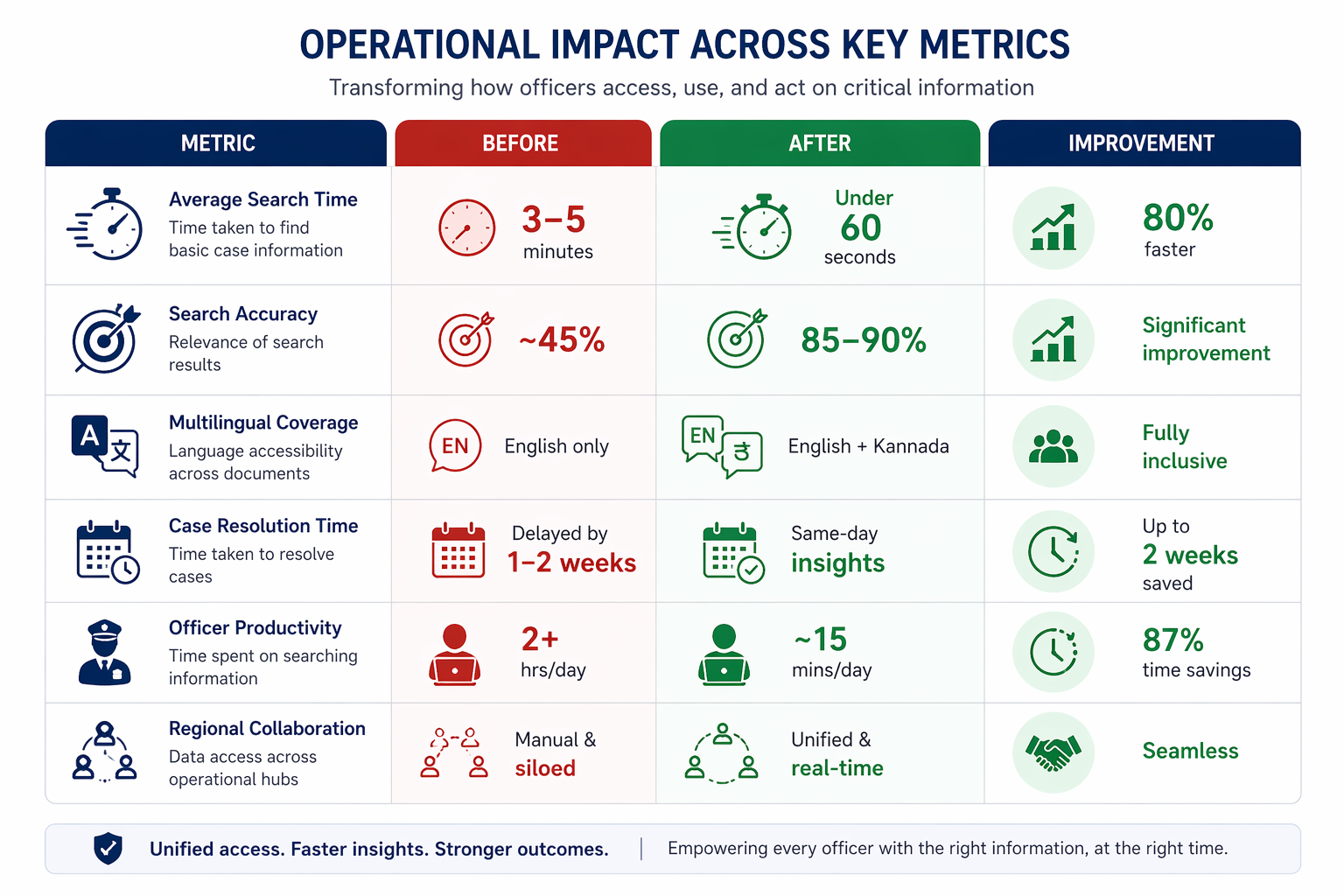
Previously, searches were largely metadata-driven and limited in scope, resulting in low accuracy and incomplete retrieval. With semantic search and unified indexing, the system began delivering context-aware and comprehensive results.
At the same time, multilingual capabilities ensured that language was no longer a barrier. Officers could search in Kannada and retrieve English documents, or vice versa, improving inclusivity and usability across regions.
Operational Impact Across Key Metrics
The transformation delivered measurable improvements across efficiency, accuracy, and collaboration:
Real-World Outcomes
Officers can now instantly access case histories, evidence, and related documentation without dependency on multiple systems or intermediaries. Regional hubs operate on shared, real-time data, improving coordination and reducing duplication of effort.
Reduced Operational Overhead
The number of IT support requests related to document retrieval dropped significantly, allowing technical teams to focus on higher-value initiatives. Manual archiving efforts were also reduced as digitization and indexing streamlined data access.
The system introduced structured access controls and audit trails, ensuring that sensitive information remains secure while maintaining full visibility into data usage and access patterns.
With unified access to data, leadership teams can now identify patterns across cases, monitor operational performance in real time, and make more informed decisions around resource allocation and prioritization.
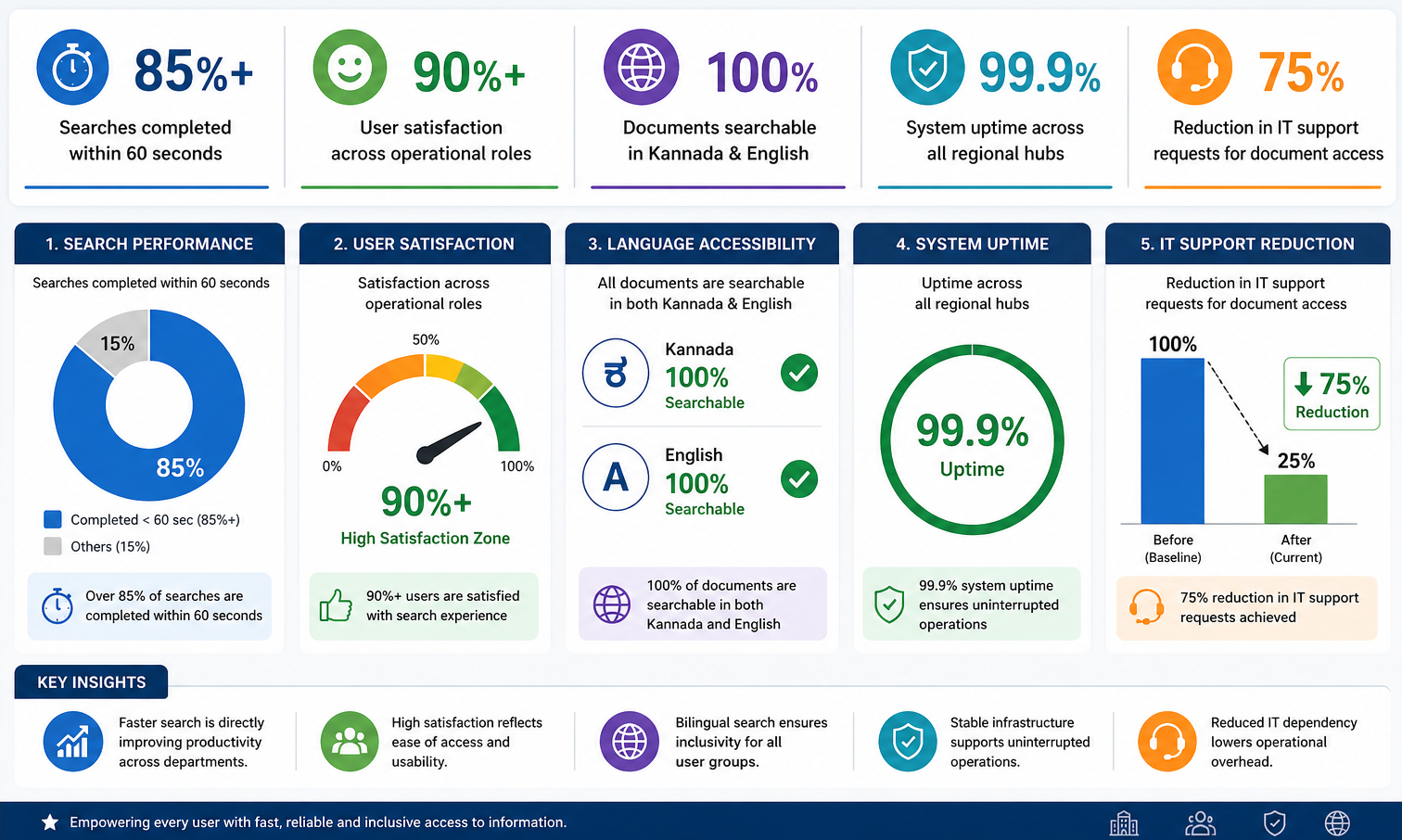
Post-Deployment Performance
Following deployment, the platform consistently delivered against key success benchmarks:
- Over 85% of searches completed within 60 seconds
- 90%+ user satisfaction across operational roles
- 100% of documents searchable in both Kannada and English
- 99.9% system uptime across all regional hubs
- 75% reduction in IT support requests for document access
Conclusion
By implementing a unified federated search platform, the Karnataka State Police transformed how operational data is accessed and utilized across the organization. What was previously a fragmented, time-intensive process is now a real-time, intelligent, and accessible system that empowers officers with the information they need when they need it. The result is not just improved efficiency, but a meaningful shift in how investigations are conducted, enabling faster case resolution, better coordination, and more informed decision-making at every level. This initiative demonstrates how the right data infrastructure can move beyond operational support to become a critical enabler of public safety outcomes.